

All life is related — and that’s not poetry, it’s biology. From the bacteria in your gut to a blue whale in the ocean, every living thing shares a common ancestor: the Last Universal Common Ancestor, or LUCA.
If we take that fact seriously, then eating, exploiting, or destroying animals stops being a matter of “choice” and becomes a question of moral consistency.
Even thinkers outside the vegan movement, like conservative commentator Ben Shapiro, have admitted that future generations will likely see meat-eaters the way we see past societies that practiced slavery — as people blinded by their own era’s norms.
The Science of Our Shared Origins
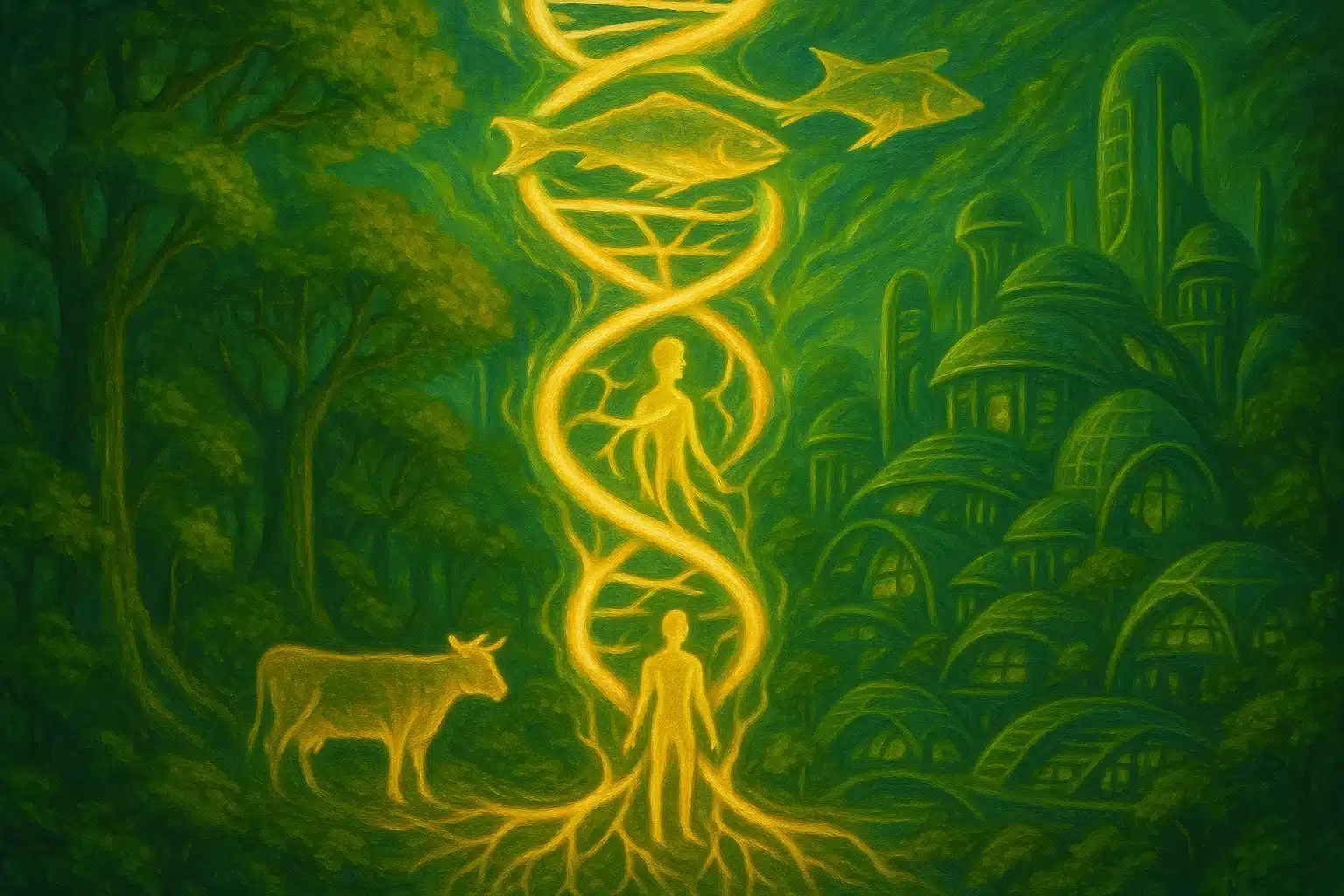
LUCA existed about 3.5 to 4 billion years ago. Through genetic analysis, scientists have found that the building blocks of every plant, animal, fungus, and microbe alive today come from the same ancient blueprint. In other words, a cow, a crow, and a cactus are not just “other” species — they are your distant relatives.
This isn’t a spiritual metaphor. It’s hard evolutionary evidence: the DNA that codes for basic cellular processes in you is almost identical to the DNA in them.
The only real difference between you and a chicken is the evolutionary path you each took.
The Ethical Leap
Once you accept that all life is related, the way we treat animals becomes a moral test.
Philosophers like Peter Singer have long argued that if we can live healthy lives without killing animals, then choosing to kill them is a moral failure.
Yuval Noah Harari calls industrial animal farming “one of the worst crimes in history,” not out of sentimentality but because it causes mass suffering to beings capable of pain, fear, and social bonds — just like us.
Even if you reject the idea of “rights” for animals, the practical case is overwhelming.
The meat industry is a climate disaster, responsible for massive greenhouse gas emissions, deforestation, and water use. By reducing or eliminating animal products, we cut down our personal environmental footprint faster than almost any other action.
Future Generations Will Judge Us
Every generation looks back at the moral blind spots of the past with disbelief. Child labor, public executions, burning people for “witchcraft” — all were once normal.
Ben Shapiro, not a vegan himself, has openly acknowledged that eating animals will likely be in that same category of moral horror when history looks back at us.
The shift won’t just be about ethics. It will be about self-preservation. The same factory farms that exploit animals also breed antibiotic-resistant bacteria and accelerate climate change.
That’s not an “animal rights” issue — that’s a human survival issue.
A World Built on Kinship
Movies like Avatar dramatize this concept — characters literally “plug into” animals, experiencing their thoughts and memories.
While we can’t do that, the genetic connection is real. The web of life is not a metaphorical tapestry but a literal one, woven from shared DNA. Every time we destroy part of it, we weaken the whole — and ourselves.
If all life is related, then veganism and eco-friendly living aren’t extreme positions — they’re the logical conclusion of the science we already know.
When future generations judge us, they won’t ask why we didn’t understand. They’ll ask why we understood and still chose to look away
Read more – The Importance of Biodiversity in a Healthy Ecosystem